

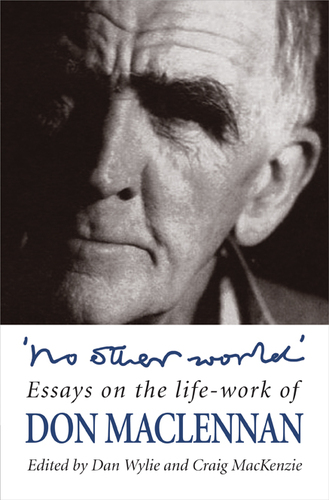
| Elzette Steenkamp speaks to Dan Wylie about 'No other world' – essays on the life-work of Don Maclennan, a volume of essays on the work of the late South African poet Don Maclennan. |
Your latest literary offering is a volume of essays on the life and work of the late South African poet Don Maclennan which you co-edited with Craig MacKenzie. Several of the contributors (a very impressive list, including Malvern van Wyk Smith, Peter Vale and Laurence Wright) knew Don both personally and professionally. Tell us a bit more about this project and its origins.
The book began as a colloquium held at Rhodes University on the first anniversary of Don Maclennan’s death in 2009. It was a heartfelt, sometimes tearful, often funny event, filled with anecdotes of our communal affection for Don as teacher and friend and colleague. The thought of making a book was always present, and it soon became clear that we had a good number of papers – some tributes-from-the-heart, some more formal studies – to form the core of a book. Craig MacKenzie wasn’t present, but soon offered to help me edit, and in fact did the donkey’s share of the close editing and proofing: a wonderful job.
The university presses were uninterested, astonishingly, pleading financial reasons, so it has been very bold of Robin Stuart-Clark of PrintMatters to take it on. And he has produced a physically very pleasing volume – and yes, it does contains contributions from some of our best national literary critics, as well contributions from others who may not be national luminaries but who knew Don intimately, and/or are poets in their own right. So it’s highly readable: a bit of a festschrift in one respect, but also some finely considered critical essays on Don’s work, mostly his huge output of poems. Peter Vale and Andre Lemmer do contribute on Don’s even more neglected involvement in drama; Gavin Stewart writes about Don and climbing; and there are other essays on translating his poetry into German, on individual volumes, on his treatment of prehistory, and the first comprehensive bibliography of his work. And we’re working on a collected poems as a companion volume.
You studied and worked with Don at Rhodes University and in many ways this volume is a personal homage to a mentor and friend. How would you describe Don Maclennan, the man?
“Craggy” might be the best word. He was lean in frame and in thought. He could be difficult, he could be unsettling in his directness, but he was the finest of friends, so generous with time and wise advice on life as well as one’s poems. A writer’s writer, deeply concerned about the well-being of literature in an increasingly illiterate country, indeed an increasingly illiterate academy. I spent a lot of time discussing poetry with him, a lot of time rock-climbing, a lot of time hunting for Stone Age tools. He strove at every instant to be authentic rather than pretentious; for me, that striving is his greatest legacy.
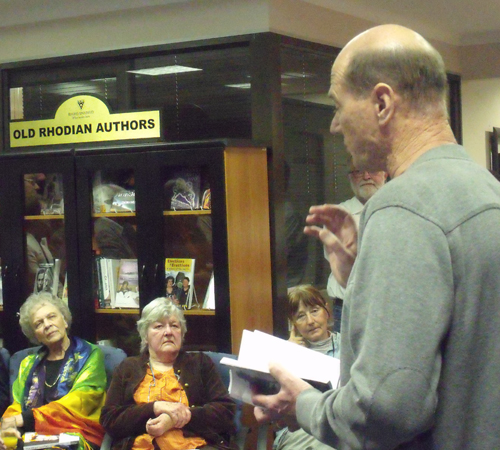 |
| Craig Mackenzie at the launch of 'No other world' – essays on the life-work of Don Maclennan |
Don Maclennan is described as “one of South Africa’s most incisive and important poets of the last few decades”, yet most of his later volumes of poetry were self-published. Does this signify an academic and public neglect of Don and poetry in general?
It has almost always been so, but poetry is marginalised increasingly because it is seen as financially unprofitable. This means not that poetry is useless, but that what counts as “profitable” is insanely narrow. We are not just walking accounting machines: even accountants live for the thrill of success, or for love; and they, too, fear, and hate, and feel lonely, or whatever. Even bankers probably spend most of their working lives thinking about family, friendships, difficulties in marriage, the adoration of their animals, and so on. And all that is precisely what literature, and preternaturally poetry, is about. But because financial resources are so skewed in their distribution and priorities, poetry gets squeezed out of the public domain. Newspaper pages devoted to reading anything at all are increasingly diminished. Even within academia I feel I am often fighting a rearguard action to keep poetry in the syllabus, against the flood of fiction. Poetry is less teachable; students find it “harder”; why teach stuff that’s a struggle and brings the pass rates down? Easier to ignore it. So if you’re going to get poetry out there it has to be by samizdat means; if you’re not into the internet, naturally becoming the medium of choice, then self-publishing at personal expense is almost the only way to go. And Don remained wedded to the book as a tactile, crafted object: his little volumes, sometimes produced in only a few dozen copies, are objects in themselves far more beautiful and sensual than any computer screen version could match.
You are yourself a renowned poet. How (if at all) has your poetry been influenced by Don’s work and your relationship with him?
I don’t know about “renowned”, but thanks. Don and I felt rather differently about actual poetry: he became ever leaner, more spare, more economical, whereas I have always favoured a density of metaphor and allusion, sometimes a more technicist language. So stylistically he didn’t influence me that much; but what he did do was teach me better how to weigh and evaluate the resonance of every syllable, how not to overstate things, how to craft lines that remained faithful to their impulse, authentic thought and emotion. Despite the differences in style – and that’s a temperamental thing – we were still after the same kinds of truthfulness.
 |
For those who are not familiar with Don’s poetry, what are the major themes and concerns that can be traced in his work?
If you glance across the references in his poetic oeuvre as a whole, the number of themes and ideas seems to become ever more elusive of summary: music, science, the cosmos, philosophy, other literatures, the natural world, his garden, politics, prehistory, friendships … All this coming out of voracious reading, which makes most other poets feel thin and emotionally jejune. I suppose he came increasingly close to death – he wrote almost all his poetry in the last twenty years of his life – he mulled more and more intensively over how to express the inexpressible delight in merely being alive, and alive to the most everyday of objects and events. There was a lot of self-doubt, or self-searching, a confrontation with the fact that whatever “meaning” there is in the universe, it’s what we make – and we can’t make anything once we’re dead. So make it now. In a country obsessed with its political past and its ramifications, this can seem self-absorbed – but even politics begins with the positioning of a self, and he tried to recognise just what that was, something that both underpins and transcends the febrile and mercurial loyalties of “party politics”.
How can our readers get hold of a copy of this volume?
Order from printmatters.co.za
|
Poems are nets of thought A poem never drains – Don Maclennan |